

The Maya was a fascinating ancient civilisation with a rich culture and heritage. Check out these fascinating Maya facts to help you learn all about the Mayan civilisation.
The Maya KS2 Topic Bundle
Immerse your class in the fascinating world of the ancient Maya civilisation with our engaging Maya Topic Bundle. This pack contains three ready-to-teach schemes of work – children will explore the ancient civilisation through the evidence they left behind in History and learn where Mexico is and explore its amazing human and physical features in Geography. The Topic Enrichment Pack also includes themed Art, DT and Geography lessons.
Each lesson in this Maya KS2 topic includes:
- a detailed lesson plan with differentiated activities
- a slideshow for the teaching input
- a range of printable resources for independent learning activities
The Spanish Conquistadors
In the early 16th centuries, Spanish explorers - including Hernán Cortés - led missions to the Yucatan pennisula of North America. Here, these explorers (who became known as the conquistadors) found the indigenous peoples of the Aztec and Maya civilisations.
In 1519, Cortes landed in modern-day Mexico. He claimed the land for the Spanish crown and began to colonise the land, taking advantage of the fact that the Maya and Aztec civilisations were made up of several competing kingdoms. Some kingdoms were conquered quickly or made early alliances with the Spanish and others resisted the Spanish conquest for almost two centuries.
So, who were the Maya and why are they so significant?

Who were the Maya?
The Maya were an ancient civilisation of people who lived in an area that used to be known as Mesoamerica. People had lived in the area from around 5000 BC but it wasn’t until around 300 BC that the first cities started to form. Before this people were hunter gatherers, or lived in small villages.
Where did the Maya live?
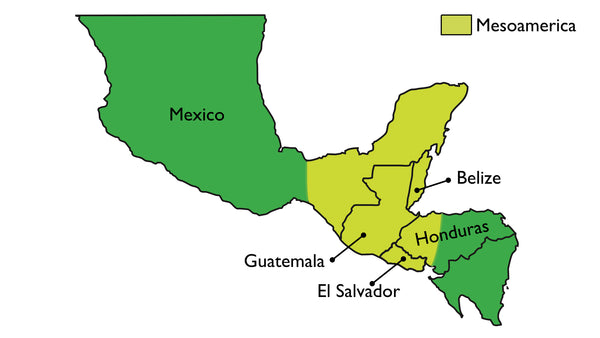
The Maya lived in an area of North America that was known as Mesoamerica but which is now the countries of Mexico, Guatemala, Honduras, El Salvador and Belize. This area is often referred to as Central America today.
Mayan City States
Mayan society was organised into city states. Each city has its own king who had complete control over his subjects. City states would often trade with each other but would also go to war frequently to try and gain power, wealth and glory for their city state.
Mayan Society
Mayan society was structured a bit like a pyramid. The higher up the pyramid you were, the more important you were:
1) King: The king was at the very top of the pyramid and was the most important person in the city state. Mayans believed that kings were chosen by the gods. This meant that a king’s orders and wished had to be obeyed.
2) Nobles and Priests: These were very important people who were educated. They were the scribes and astrologers of society. They lived in grand houses.
3) Palace Officials: These were also very important people. They were in charge of the day-to-day running of the city.
4) Craftsmen: Craftsmen included anyone who had a skilled job, such as a stonemason, tailor or woodcarver.
5) Farmers: Most ordinary people in Mayan society were farmers. They usually lived in small settlements and lived simple lives.
6) Labourers: Labourers did the hard manual labour that was needed to build temples and other buildings. Labourers were paid a very low wage.
7) Slaves: Slaves were at the very bottom of the social pyramid. They also had to do hard labour, and anything else they were told to do, but they didn’t get paid for their work. They were given food and shelter by their masters.

Mayan king and his nobles
Teachers: Check out our Mayan City States lesson if you're looking for more in-depth teaching materials about Mayan society.
What were Mayan houses like?
The most common houses had walls made of stone or mud. They had thatched roofs. Mayan houses were oval in shape and had just one room. Families would all live and sleep in one room. Extended family members would build their houses next to each other and would often share a kitchen garden to grow fruits and vegetables to eat.

Rich Maya lived in much more elaborate houses built of stone, often on raised platforms.
What did the Maya eat?
Maize was a staple part of the Mayan diet, along with beans, pumpkins, squash, tomatoes, avocados, chillies, papaya, pineapple, limes and many other fruits and vegetables. They also ate fresh meat from the animals they kept or hunted, like fish or turkey.

Mayan Gods
The Maya believed in hundreds of different nature gods who ruled people’s lives and decisions, such as the gods of maize, the Sun and fire. The lives of the Maya revolved around religion; they had many special ceremonies and rituals to honour the gods and ask for blessings. Cities had special temples where people went to worship and offer the gods gifts.
As well as gifts, the Maya believed that they had to offer blood sacrifices to the gods. They believed that if they didn’t, the Sun wouldn’t rise and the world would end. Blood sacrifices could be given in many ways. Rulers, for example, would pull spiky ropes through their tongues to draw blood, or fingernails would be pulled from slaves or captives.

10 Mayan Gods:
- Itzamna is a creator god who was one of the creators of human beings
- Kinich Ahau is the sun god
- Ix Chel is the goddess of medicine and midwifery
- Chaac is the god of rain and storms
- Ah Bolon Tzacab is the god of farming who is also associated with royal power
- Buluc Chabtan is the god of war, violence and sudden death
- Hun Hunahpu is the god of maize
- Awilix was the goddess of night and the moon
- Bahlam is the jaguar god of the underworld
- Colel Cab is the goddess of bees
Mayan Writing
The Maya had a writing system made up of glyphs. Glyphs are signs that represent a word or sound. The Maya had more than 800 glyphs in their writing system! At first, historians didn’t think that the signs represented writing at all, or at least not a complete writing system. It wasn’t until the 1950s that it was proved to be a language. After that, people were able to start translating the writing the Maya left behind and learn more and more about their society and culture.

Mayan Maths
The Mayan number system involved using lines, dots and shells. A dot represented one, a line represented five and a shell represented zero. Any number could be made with the combination of these symbols.

Did you know…?
The Maya had a symbol for zero way before the Europeans did.
Teachers: If you're looking a lesson on Mayan writing and number systems, check our Mayan Writing lesson.
The decline of the Mayan civilisation
- Drought and crop failure leading to food shortages
- Warfare between rival tribes intensified
- Declining trade meant cities could not sustain their populations
- An increase in diseases meant a declining population
- A natural disaster killed everyone

Historical Sources


The Dresden Codex (12th-14th century)
If you enjoyed reading this blog, have a look at some of our other fact blogs.
Teachers: If you're looking for more resources to teach the Maya to your class, check out our collection of Maya downloadable PDFs, including an in-depth KS2 cross-curricular Maya Topic with lesson plans, slideshows and printable resources.


15 Comments
Great info good for grade 4!!!
AMAZING
This was so useful for my assignment, I learnt so much, highly recommend!
Very nice thumbs up from me